
(Please note – recipe has been updated for the pineapple filled version at 4.51pm today.)
For those who have been listening to the discussion on ABC radio Sydney over the past couple of weeks, there’s been discussion with Indira Naidoo and I and listeners regarding bakery favourites. One intriguing item that was the centre of much discussion with the pineapple doughnut – a very popular delicacy and hard to come by.
Apparently Norman Gunston used to give one of these to each of the guests on his show.
I’d not heard of them at all, but as listeners progressively rang in describing this gastronomic delight, it seemed more and more like a good idea to try to develop and make them.
Apparently they are not easy to come by these days (certainly not here in Tasmania), so that provided extra incentive.
They were apparently a plain doughnuts that after cooking, were dipped in a lovely pineapple syrup. This, my research informed me, was the original rendition.
Other listeners spoke of an iced version, a more recent rendition, very nice but not quite up to the mark of the soaked version.
I took it a step further, just for the fun of it, and made a doughnut with a slice of pineapple enclosed.
I trialed the soaking and then the icing method. Next, the all important test tasting. There’s never a shortage of those between people who drop in and the Wednesday morning tea group (The Custard Club).
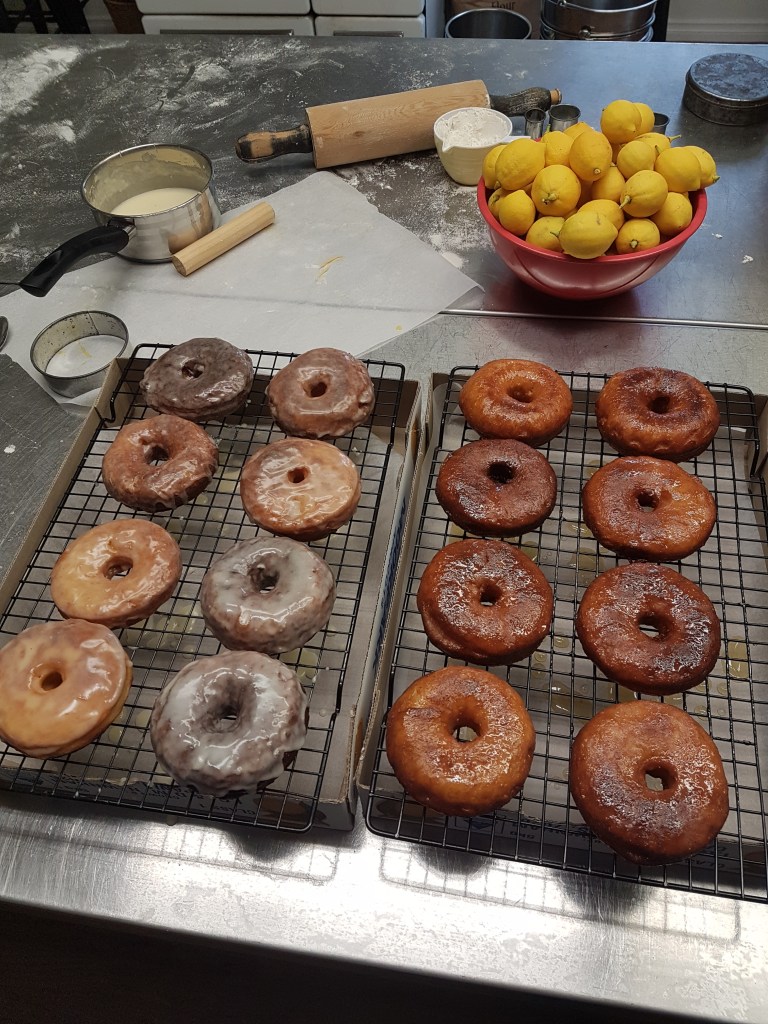
The verdict? The soaked version with the pineapple ring enclosed was the winner, though one or two preferred the iced. Oh yes, and I did a few that were both soaked, then iced just for the fun of it. They were my personal favourite, but a bit sticky to handle.
A final hint from one of the test tasters – cook the doughnuts holes, they are delicious. I did, they are, especially soaked in the syrup.
Anyway, enough preamble – below is the recipe for all options. Please feel free to contact me if you have any questions.
Pineapple Doughnuts
If using the soaked in glaze option, it’s important to make the glaze first and allow it to cool. For the icing it doesn’t matter if it is left until a bit later to prepare. Relates to the plainer doughnuts.
At the end, there are instructions for making the version that encloses a pineapple ring.
For the Pineapple Glaze option
1 cup pineapple juice
2 cups sugar
1 tablespoon lemon juice
For the Pineapple Glace Icing Option
2½ cups icing sugar
2 teaspoons melted butter
2 teaspoons lemon juice
1/3 (one third) to ½ cup pineapple juice, approximately
For the dough
3 cups plain flour
3 teaspoons instant dried yeast
½ teaspoon baking powder
1 teaspoon salt
2 tablespoons sugar
85g salted butter, melted and cooled to lukewarm
2 egg yolks
1 cup lukewarm milk, approximately
METHOD
To make the pineapple glaze
Place all ingredients in a deep medium to large saucepan.
Bring to the boil, stirring, then reduce heat and cook without stirring for 3 minutes more (Be careful that it doesn’t boil over). Remove from heat and cool to room temperature.
To make the pineapple glace icing
Mix all ingredients together to make a soft icing consistency, suitable for dipping. Set aside. Stir before using.
To make the dough
Mix the flour, yeast, baking powder, salt and sugar together in a large bowl. In a separate bowl, whisk together the melted butter, egg yolks and milk until just combined.
Make a well in the centre of the dry ingredients and pour in this liquid. Mix to a soft dough, adding only if necessary, just a little more milk.
Place a tea towel over the bowl and leave to rise for approximately one and a half hours until the dough is at least one and a half times to twice its original size.
Turn the dough out onto a lightly floured surface, sprinkle with flour and knead for approximately 3 minutes or until the dough is smooth and elastic. Leave to stand 5 minutes, then roll out on a lightly floured surface to 1cm thick.
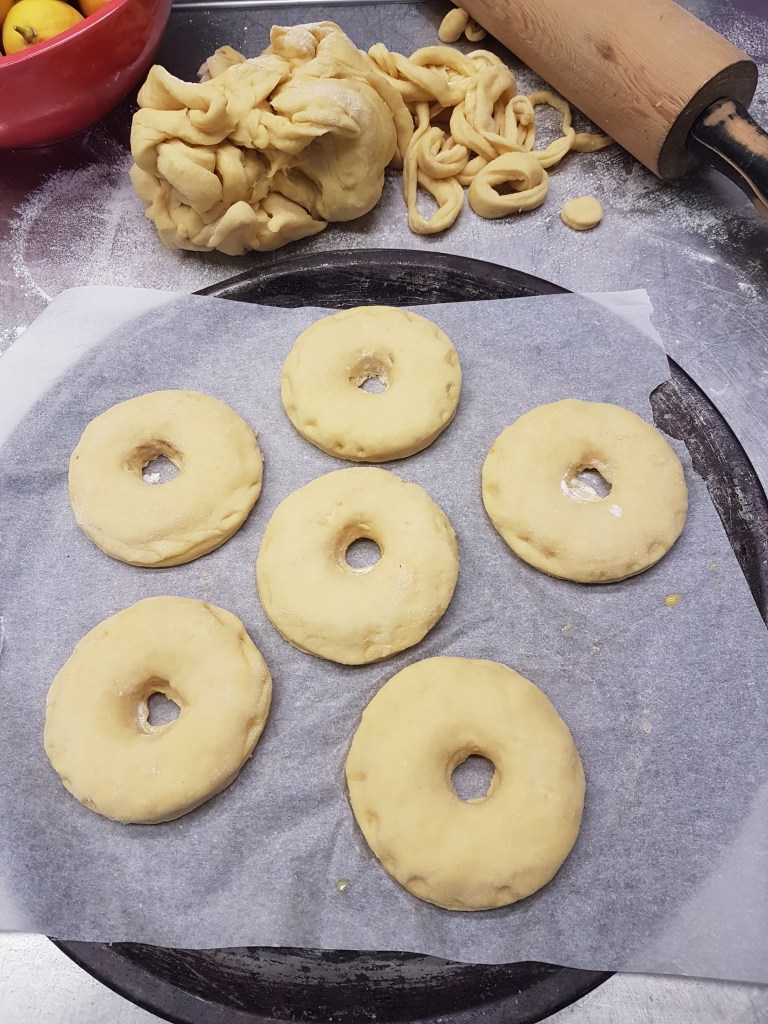
Cut into 7cm rounds with a sharp cutter, and then cut a hole in the middle with a 2cm round cutter. Place on baking paper on a tray, allowing a little room for spreading, and leave to rest for 20 minutes.
Fill a large frying pan with canola oil (or similar) to a depth of 3 cm.
Towards the end of the dough’s resting time, heat the oil to around 180 degrees C.
Place 3 or 4 (no more) of doughnuts in the pan and immediately reduce heat a little (to about 160 degrees C).
Cover the pan and cook for 3 minutes. Remove cover and turn the doughnuts and cook uncovered for a further 4 minutes. (I check to see if they are cooked through with the tip of a small sharp knife inserted into the side.)
Remove to a tray that is lined with paper towel.
For the Pineapple Glaze option
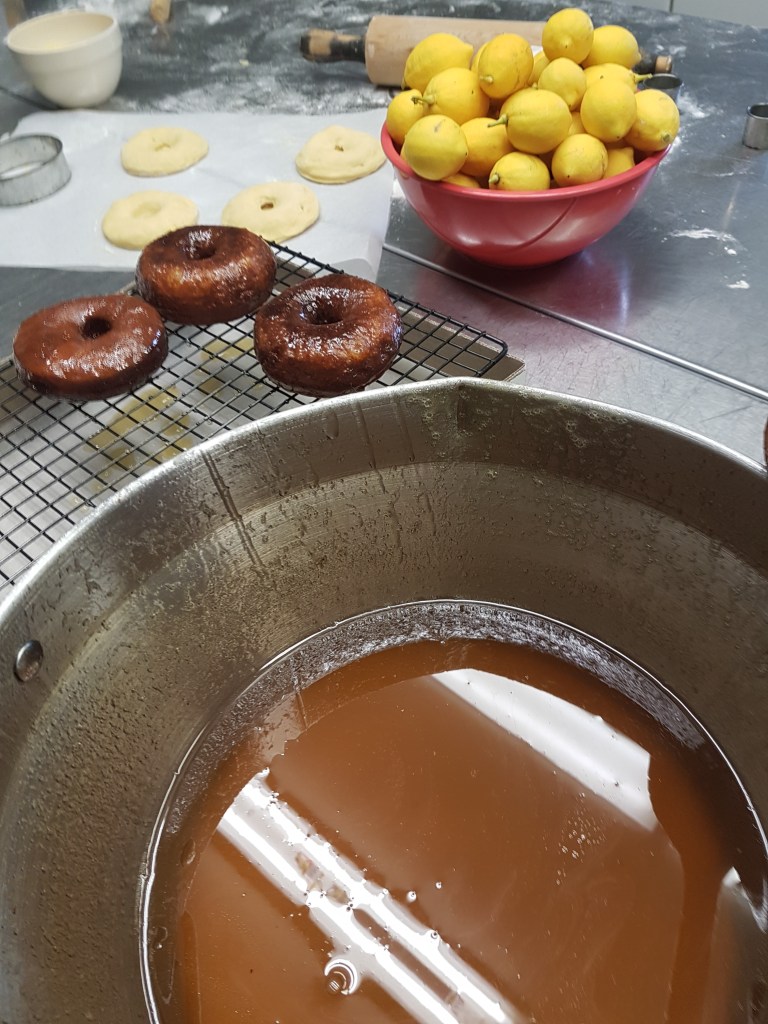
Place the HOT doughnuts two or three at a time in the pineapple glaze and leave to soak for 2 minutes. Turn and leave a further 2 minutes, then remove to a wire rack (that has a tray under it to catch drips).
Repeat with the remaining doughnuts.
For the Pineapple Glace Icing Option
Stir the icing until smooth again. Dip the tops of doughnuts, while they still warm. in the icing and then place on a wire rack, icing side up, with a tray underneath to catch the drips.
————————————————————————————————————————————————————-
Pineapple Doughnuts with enclosed Pineapple Rings
10 thinly sliced pineapple rings – fresh or tinned
1 batch of dough
1 egg, lightly whisked
Drain the pineapple rings on paper towel, turning once to make sure they are as dry as possible.
Make the dough as per recipe above, leaving to rise and then knead and rest as specified.
Roll dough out to 5 to 6mm thickness. With a 9cm cutter, cut out 20 circles – you may need to re-roll scraps of dough. If so, gather the scraps into a ball and leave to stand 5 minutes before re-rolling.
Whisk the egg lightly with 3 teaspoons cold water. Brush half of the circles with this.
To enlarge the hole in the middle of each pineapple ring, cut with a 3.5 cm cutter.
Place a pineapple ring on the egg glazed circles. Place another (unglazed with egg mixture) circle over the top and press the edges together firmly. Press the dough down in the centre.
With a 2cm cutter, cut the centre out of the doughnut. Ensure edges are still sealed well.
To neaten the outer edges, cut again with the 9cm cutter, again ensuring that the edges are still sealed together.
Place on a tray lined with baking paper, allowing a little room for spreading. Leave to rest for 20 minutes, covered loosely with a tea towel before cooking as for the plainer doughnuts.
Dip or ice according to preference.
 sallywise.com.au