
.
When I was asked to research the topic of Anzac biscuits (by ABC Sydney Evenings), I had no real concept of how intriguing their history was, how evocative the memories surrounding them, and what they represent to this day.
It is a biscuit that was created out of love, care and necessity in the scary times of World War I.
Wives, mothers and girlfriends of soldiers on the front line were very concerned for the nutritional wellbeing of their loved ones, knowing that the rations included bully beef and hard tack (a very hard thin biscuit that was so tough that soldiers were said to grate them into tea to make “trench porridge”).
However, there were challenges presented in sending food to the troops. The journey would take two months or more by sea, so any edibles had to be able to remain foodsafe until they reached their destination.
Early renditions of the biscuit contained eggs and spices. However, eggs were hard come by with most poultry farmers going to war, and their inclusion also increased the risk of spoilage. The womenfolk collectively pooled their knowledge and expertise and reasoned on readily available pantry ingredients to come up with the Anzac biscuit such as we have today, or very similar.
At first the biscuit contained oats, sugar, flour, butter, golden syrup, bicarbonate of soda and boiling water. The first recipe appeared in print in 1920 in The Argus newspaper. The golden syrup was the binding ingredient and also helped preserve them.
Coconut did not appear in any Anzac biscuit recipe until 1927 (though one source claimed 1924).
For the soldiers who received these care packages from home they were the ultimate in comfort food. It was not only the fact that they tasted delicious, but it was a great morale booster, to know that their loved ones at home were thinking of them and taking the time to make, bake and send the biscuits.
To this day the Anzac biscuit remain popular, especially at this time of year with Anzac Day just around the corner. Baking the biscuits alongside children is a good way to educate them about the World War I war effort and the lessons that can be learned from the history.
The meaning of ANZAC and all that it encompasses has become very important, so much so that in 1994 legislation was introduced regarding Anzac biscuits. For commercial sale for instance, the product must conform to the traditional recipe and shape and they must NEVER be called “cookies”.
Whether we agree with or are aghast at the reality of war, there is no doubt that the sacrifice of the ANZAC troops so long ago deserves our recognition and appreciation.
In our house, Anzac biscuits have been a constant for more than 50 years. The Anzac barrel is always kept replenished, at the ready for when friends come to call.They are as they have always been, delicious and nutritious and keep really well.
Here I am providing the recipe for my crispy Anzac biscuits.
If you would prefer the softer, chewy version, just bake for less time. It’s also helpful in that case to refrigerate the mixture for half an hour before rolling into balls and baking.
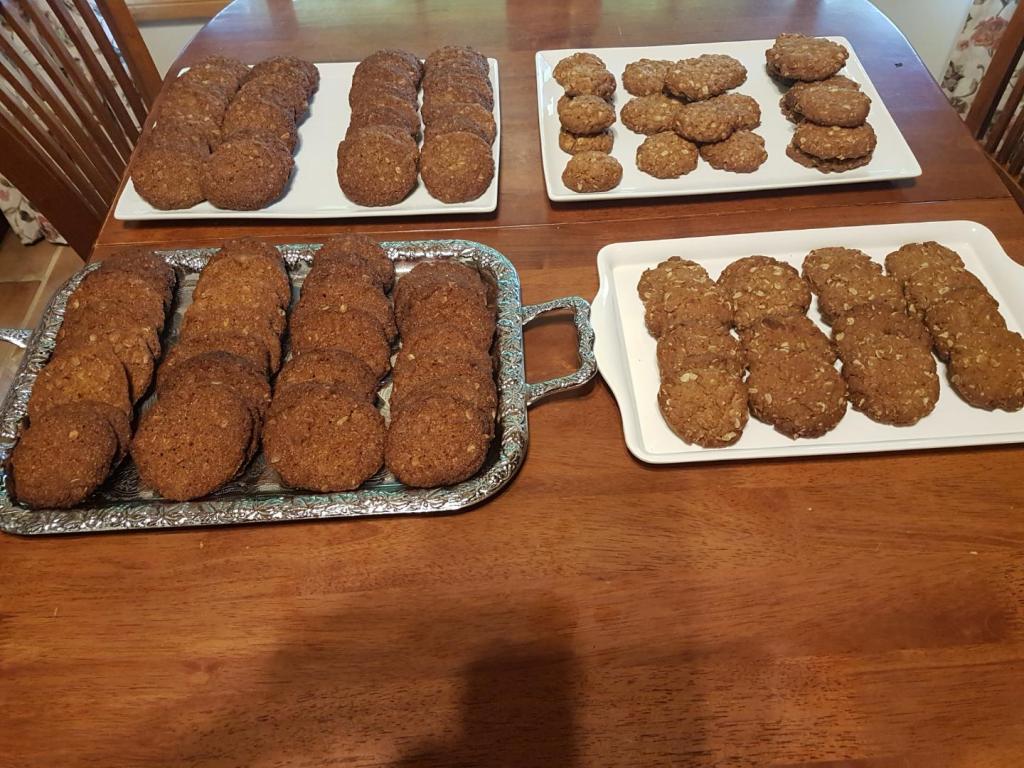
Incidentally, the photo below is of some various versions I trialed recently in tandem with the research – the left platter are my recipe Anzacs, with some chew (the ones to the right of the back left platter), the right back platter made from the first printed recipe, containing no coconut, and the bottom right is a CWA recipe that used brown sugar instead of white.
Anzac Biscuits
Ingredients
125g salted butter
90g golden syrup
50ml boiling water
1 teaspoon bicarbonate of soda
150g plain flour
60g desiccated coconut
80g rolled oats
190g sugar
Method
Heat oven to 150 degrees C (fan forced). Line 2 baking trays with baking paper.
Melt the butter and golden syrup together over low heat (do not allow to boil).
In a cup mix the boiling water and bicarbonate of soda together and stir till dissolved.
In a large bowl mix the dry ingredients together.
Make a well in the centre and pour in the butter/golden syrup mixture, along with the bicarbonate of soda/water mixture.
Mix well with a metal spoon until well combined. Leave to stand for 10 minutes at room temperature (for crispy) or refrigerate for 30 minutes, which will help make a softer biscuit.
Roll 25g (or 20g) portions of the dough into balls and place on the trays, allowing ample room for spreading.
Bake for approximately 15 minutes until the Anzacs are medium brown. Allow to cool on trays for about 3 minutes to firm up a bit, then remove the biscuits to a wire rack to cool completely.
FINALLY, if you would like the recipe for the originals, it can be found on the Australian War Memorial’s website : https://www.awm.gov.au/articles/encyclopedia/anzac/biscuit/recipe
If you do use this latter recipe – a hint. I found that the biscuits needed to be flattened on the tray before baking and I used 30g ball of dough for each biscuit.
 sallywise.com.au